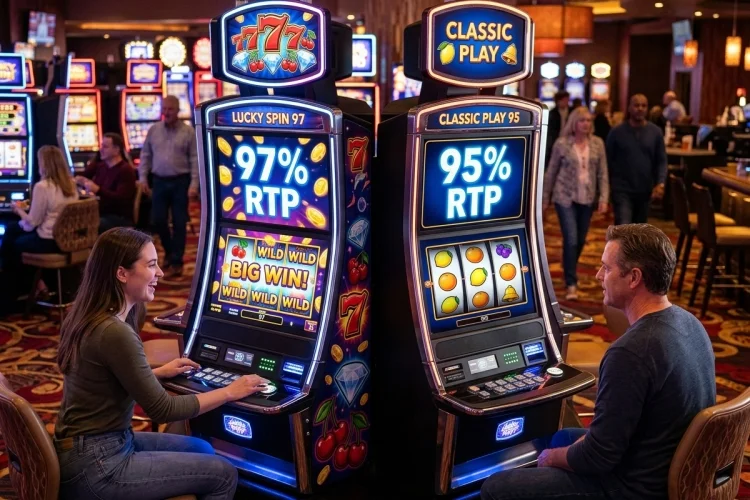

You find your favorite slot at two online casinos. The title, graphics, reels, and bonus features look identical, but one version lists 96% RTP while the other shows 94%. Is one of them wrong?
Not necessarily. Can the Same Slot Have Different RTP Settings? Yes, and this has become fairly common in online gaming. Many software providers create several approved mathematical versions of the same title.
Understanding why those variants exist, what actually changes, and how to identify the version you are playing can make slot comparisons much more useful.
What Does RTP Actually Measure?
RTP stands for return to player. It represents the theoretical percentage of total stakes that a game is designed to return to players over a very large number of rounds.
A 96% RTP does not mean that wagering $100 will leave you with exactly $96. One session might finish far above that figure, while another could lose most of its starting balance.
RTP becomes meaningful over extremely large statistical samples. The UK Gambling Commission therefore treats RTP as information about the game’s theoretical return rather than a promise about an individual session.
This distinction is important because comparing 96% and 94% variants is about long-term mathematics, not predicting what will happen during your next 50 spins.
Yes, Providers Can Create Multiple RTP Versions
A slot developer can build and certify several mathematical configurations under the same game title.
Hacksaw Gaming provides a clear example with Wanted Dead or a Wild. Its official game information lists RTP options of 96.38%, 94.55%, 92.33%, and 88.42%. The game still carries the same Western theme, bonus rounds, 15-payline structure, and 12,500x maximum win.
Quickspin’s Reel Nightmare follows a similar model. The developer offers the title at 96%, 94%, 92%, and 87% RTP.
So the game name alone does not always identify one fixed theoretical return.
Some Providers Use RTP Variants Across Their Portfolio
Multiple RTP options are not limited to one or two unusual titles.
Play’n GO has publicly explained that it certifies slot games for several theoretical RTP levels, including targets around 96%, 94%, 91%, 87%, and 84%, with some regional variation.
Quickspin also publishes titles such as Shields of Lambda in four configurations: 96%, 94%, 92%, and 87%. The company describes these options as helping its games work across different markets and margin requirements.
This means variable RTP is often intentionally designed into the product before a player ever sees it.
Think of it as several mathematically different editions sharing the same artwork and basic mechanics.
Why Would Casinos Offer Different Versions?
Commercial structure is one reason.
A 96% theoretical RTP corresponds to a 4% theoretical house margin, while a 92% version corresponds to an 8% margin. That does not mean a casino literally keeps exactly 4% or 8% of every player’s session because short-term variance can be huge.
Across enough wagering, however, theoretical margins matter to operators.
Quickspin directly states that some of its multiple RTP configurations are intended to provide healthy margins across different markets.
Regional regulation, supplier agreements, platform arrangements, promotions, taxes, and commercial strategy can all influence which approved variant is made available.
Does a Lower RTP Change the Appearance?
Usually, the difference is much harder to see than you might expect.
The reels may use the same symbols. The soundtrack can be identical. The same free-spin feature may appear, and the maximum advertised win might remain unchanged.
The difference sits inside the mathematical configuration.
A developer can alter how theoretical return is distributed across base-game wins, bonuses, symbol combinations, or other probabilities while preserving the overall visual experiance.
That is why simply watching a slot is not enough to determine its RTP version.
Jammin’ Jars Shows How Casino Versions Can Differ
Push Gaming is unusually clear about this on its Jammin’ Jars product page.
The developer currently lists 96.83% and 94.25% RTP configurations. More importantly, it explicitly states that RTP may vary per casino and says the game’s active RTP can be found in the user panel and loading screen.
This is exactly why online reviews need to be treated carefully.
A review may correctly state that Jammin’ Jars has 96.83% RTP, but the casino you visit could be running the approved 94.25% configuration instead.
Both statements can technically be correct.
Can a Casino Change RTP While You Are Spinning?
This is where an important distinction is needed.
Having several approved RTP variants does not mean a regulated operator can freely change your probabilities in the middle of a session because you have been winning.
UK Gambling Commission technical standards require random outcomes to be generated fairly and prohibit adaptive behaviour that changes probabilities during play.
Its rules also state that payouts, rules, and outcome probabilities generally cannot be changed while a game is available for gambling without following specific procedures and notifying customers appropriately.
So it is more acurate to think of casinos as offering a particular configured version, rather than constantly moving an RTP slider behind the scenes.
How Much Difference Does 2% Really Make?
Over ten spins, potentially very little. Random variation can completely overwhelm the theoretical difference.
Over huge wagering volumes, however, percentage points become meaningful.
Suppose cumulative stakes eventually reach $50,000. Purely as a theoretical illustration, 96% RTP represents $48,000 in expected long-term return, while 94% represents $47,000.
That is a $1,000 mathematical difference across the same wagering volume.
Actual individual results could still be dramatically higher or lower. RTP is an expectation, not a scheduled payout.
RTP Does Not Tell You How Often You Will Win
RTP and volatility answer different questions.
RTP describes theoretical long-term return. Volatility describes how that return tends to be distributed between smaller, more frequent outcomes and less frequent, potentially larger payouts.
Wanted Dead or a Wild, for example, carries several possible RTP configurations while Hacksaw Gaming separately rates its volatility at four out of five.
That means choosing a higher RTP does not guarantee smoother gameplay or more winning spins.
Hit frequency, bonus frequency, maximum win, and volatility should be evaluated seperately.
Always Check the Version Inside the Game
When multiple configurations exist, the information inside the loaded game is more useful than a generic Google result.
Open the help menu, information panel, paytable, settings screen, or loading information. Under UK Gambling Commission standards, applicable rules and information such as RTP, house edge, or winning probabilities must be made available to customers before they gamble.
Push Gaming’s Jammin’ Jars is a practical example because its provider specifically directs players to the user panel or loading screen to identify the active percentage.
Checking takes seconds and prevents an easy comparision mistake.
So, Can the Same Slot Have Different RTP Settings? Absolutely. Developers such as Hacksaw Gaming, Quickspin, Push Gaming, and Play’n GO offer approved RTP variants of their games.
The title may look identical while the mathematics underneath differ. Before playing, check the RTP inside the actual game, compare volatility and features as well, and never assume an RTP listed in one review applies everywhere.